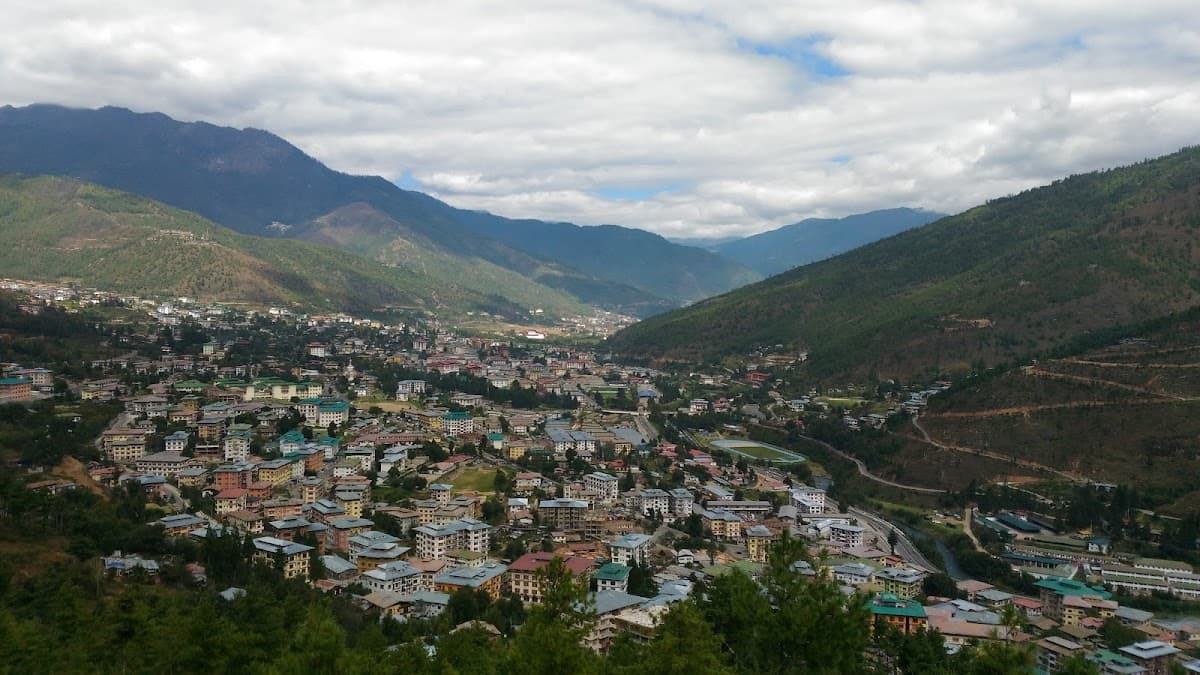
Thimphu
World's only capital without traffic lights in Himalayan kingdom
Thimphu breaks every rule about capital cities. No traffic lights. Prayer flags flutter above government buildings. Monks in maroon robes walk past internet cafes. This is Bhutan's capital – a city where policemen direct traffic with white gloves and ancient dzongs house modern ministries. At 7,710 feet above sea level, Thimphu sits in a valley where the Wang Chhu river cuts through mountains that scrape the sky. You'll find weekend markets selling yak cheese next to shops hawking the latest smartphones. It's a place caught between worlds – and that's exactly what makes it fascinating.
Best Months
MAR · APR · MAY · SEP · OCT · NOV
~21°C · moderate crowds
Culture & Context
BUDDHISM MEETS MODERNITY
Thimphu sits at 2,330 meters above sea level in western Bhutan's Wang Chhu valley. It's been the country's capital since 1961, home to around 100,000 people — roughly one-eighth of Bhutan's entire population. Here's the thing about this city: monks walk past coffee shops with smartphones.
Traditional dzong architecture sits next to hip cafes. And the intersection at the city center has no traffic lights. A white-gloved police officer directs traffic instead, and it actually works.
Buddhism isn't a backdrop here — it's woven into the daily rhythm of life. The government's Gross National Happiness philosophy isn't just a tourist tagline; it genuinely shapes policy, tourism rules, and how locals interact with the world. Bhutan limits visitor numbers on purpose.
That means it's expensive and relatively uncrowded. For most international visitors, independent travel is not allowed — you must book through a licensed tour operator who provides a certified guide. Your guide handles permits, routes, and entry fees.
Think of it less like a tour and more like having a well-connected local friend who happens to know every checkpoint on the road.
Local Customs
RESPECT SACRED SPACE
Walk clockwise around stupas, chortens, and prayer wheels — locals do this instinctively and call it 'kora'. Going the wrong way is noticeable.. Remove shoes, hat, and sunglasses before entering any temple or dzong.
Long sleeves and long pants or skirts are required at religious sites — no exceptions, no shortcuts.. Greet people with a slight bow and open hands. Handshakes are becoming more common in Thimphu, but hugging or public kissing is not culturally normal, especially near religious sites..
Use both hands when giving or receiving anything — money, gifts, a cup of tea. Single-hand exchanges can read as dismissive.. Never point at people or sacred objects with your finger.
Use an open palm facing upward instead.. Feet are considered the lowest part of the body. Don't point them at people, religious items, or altars when sitting.
Cross-legged is the way to go.. Smoking in public is banned. Bhutan has some of the strictest anti-tobacco laws in the world.
Designated indoor areas only — and even then, it's rare to see it done openly.. Don't give sweets or money to children who ask. It encourages begging and goes against the principles Bhutan has built its tourism model around..
Say 'meshu meshu' and place your hand over your bowl to decline more food — otherwise your host will keep refilling it, which is their way of showing care.. Drones require prior permission and the rules are enforced. Don't assume you can fly one for a shot of Tashichho Dzong..
When attending a festival like Thimphu Tshechu, remember it's an act of devotion, not a performance staged for tourists. Dress modestly, speak quietly, and ask before photographing monks or elders.. Add 'la' to the end of phrases when speaking to elders or in formal situations — it signals respect and locals genuinely appreciate the effort.
Safety
EXCEPTIONALLY SAFE
Thimphu is exceptionally safe. Crime rates are extremely low and there's a strong community culture. Solo female travelers face minimal risk.
Walking alone at night in central areas is generally fine, though basic street awareness applies anywhere. The bigger risks are environmental: Bhutan is mountainous and landslides happen during monsoon season (July–August), sometimes cutting roads. Monitor conditions through your tour operator if you're traveling between towns during that window.
Altitude is a real consideration — Thimphu sits at 2,330 meters. Give yourself a day to acclimatize before doing anything strenuous. There are no significant tourist scams to worry about, partly because all tourism is managed through licensed operators.
Basic medical facilities exist in Thimphu; carry your own medications for anything beyond the ordinary.
Getting Around
GUIDED VEHICLE ONLY
You can't get to Thimphu by air directly. Paro International Airport is the only entry point by air, 51km away (about a 1.5-hour drive on mountain roads).
Your licensed tour operator arranges the airport transfer as part of your package. Within Thimphu, taxis are available and easy to hail on Norzin Lam. The central area is compact enough to walk.
Local buses run on major routes but aren't geared toward tourists. For travel beyond Thimphu to Punakha or Paro, you're in a private vehicle arranged by your guide. Budget 4–6 hours for Paro–Thimphu–Punakha drives; the roads are winding and scenic but not fast.
Bhutan has no trains. From India by land, the route runs through Phuentsholing — a bus from Phuentsholing to Thimphu costs INR 250 versus INR 3,500+ for a taxi, but note that the bus ticket window closes by 5 PM.
Useful Phrases
Money-Saving Tips
- 1.Use ngultrum instead of US dollars - you'll get better rates and avoid confusion at small shops
- 2.ATMs are scattered around the city center, but bring backup cash as they sometimes run empty
- 3.Weekend market prices are negotiable, especially for handicrafts and souvenirs
- 4.Hotel rates drop significantly during monsoon season (June-August) if you don't mind the rain
- 5.Taxi fares are fixed for most routes - ask locals what the standard price should be
- 6.Restaurant meals cost $3-8 for local food, $8-15 for tourist-oriented places
- 7.Buy a local SIM card for 200 ngultrum instead of using expensive roaming charges
Travel Tips
- •Pack layers - mountain weather changes quickly and mornings are always cold
- •Respect photography rules at dzongs and monasteries - ask before taking pictures
- •Learn basic Dzongkha phrases like 'kuzuzangpo' (hello) - locals appreciate the effort
- •Carry tissues everywhere - public restrooms rarely have toilet paper
- •Download offline maps before arriving - GPS can be spotty in the mountains
- •Book accommodations well in advance during festival seasons
- •Bring altitude sickness medication if you're sensitive - Thimphu sits at 7,710 feet
- •Dress modestly when visiting religious sites - cover shoulders and legs
- •Try local food but start mild - Bhutanese cuisine is seriously spicy
- •Exchange money at banks rather than hotels for better rates