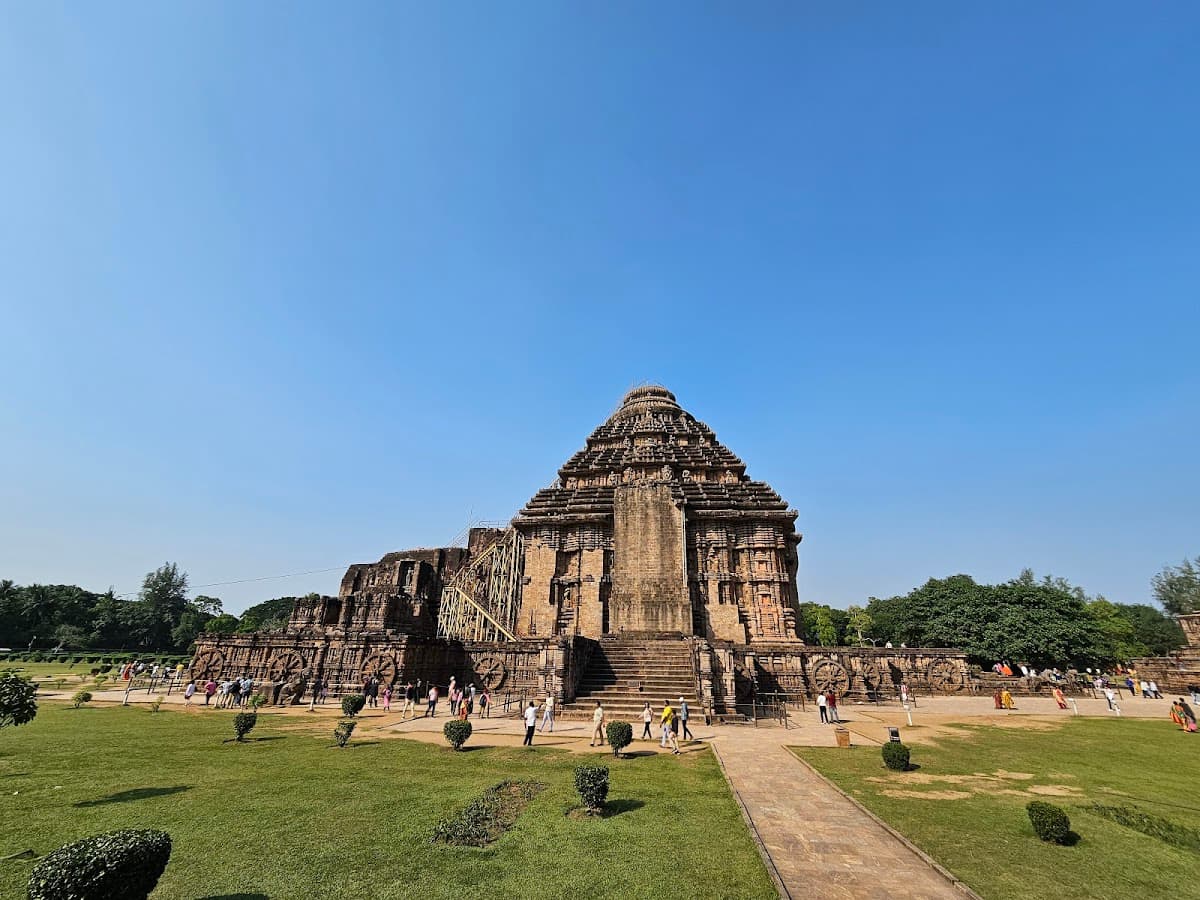
Konark Sun Temple
Ancient stone chariot dedicated to the sun god
The Konark Sun Temple rises from the Odisha coastline like a massive stone chariot frozen in time. Built in the 13th century as a tribute to Surya, the sun god, this UNESCO World Heritage site represents one of India's most ambitious architectural achievements. The entire temple complex was designed as a colossal chariot with 24 intricately carved wheels, each measuring 10 feet in diameter, pulled by seven horses racing toward the dawn.
King Narasimhadeva I commissioned this marvel around 1250 CE, and legend says it took 1,200 artisans 12 years to complete. But here's the thing — what you see today is just a fraction of the original structure. The main sanctum collapsed centuries ago, leaving behind the jagamohana (audience hall) and the natamandira (dance hall) as stunning remnants of what was once called the "Black Pagoda" by European sailors.
The temple isn't just about size — it's about details. Every surface tells a story through stone carvings that range from celestial dancers to erotic sculptures, from mythical creatures to scenes of daily life in medieval India. The artisans used a technique called dry masonry, fitting massive stones together without mortar, creating a structure that has withstood cyclones, earthquakes, and eight centuries of coastal weather.
Money-Saving Tips
- 1.Entry is free for Indian citizens, ₹40 for foreign visitors — bring ID proof
- 2.Hire certified guides at the entrance for ₹200-300, much cheaper than private tour operators
- 3.State buses from Bhubaneswar (₹45) and Puri (₹25) cost fraction of private taxis
- 4.Pack lunch and water — temple complex has limited expensive food options
- 5.Government handicraft shops offer fixed prices, avoiding haggling with street vendors
- 6.Combine with nearby Chandrabhaga Beach (free entry) for a full day experience
- 7.Visit during weekdays to avoid weekend crowds and higher accommodation rates in nearby cities
Travel Tips
- •Visit at sunrise or sunset when the chlorite stone glows golden against the sky
- •Wear comfortable walking shoes — temple grounds have uneven stone surfaces
- •Bring sun protection and water — limited shade available in the complex
- •Hire a certified guide to understand the astronomical and mythological significance of carvings
- •Photography allowed in complex but prohibited inside the Archaeological Museum
- •Don't climb on sculptures or wheels — fines up to ₹5,000 and it damages ancient stone
- •Best weather October-March; avoid monsoon season (June-September) for travel disruptions
- •Combine with Puri's Jagannath Temple and Chilika Lake for a complete Odisha cultural circuit
Frequently Asked Questions
BUILD YOUR
KONARK SUN TEMPLE PLAN
Insider picks, smart timing, and a plan ready when you are.
Start Planning