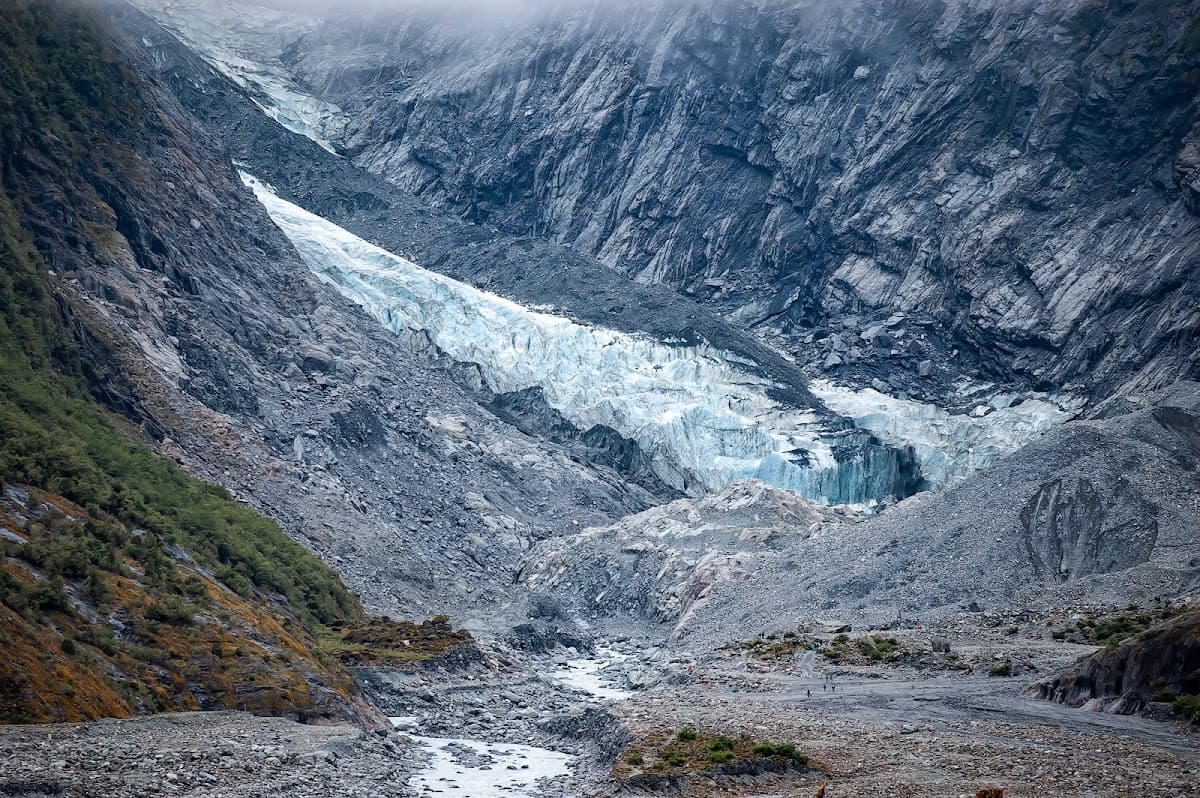
Franz Josef
New Zealand's Glacier Adventure Gateway Village
Franz Josef sits in the middle of nowhere on New Zealand's wild West Coast, and that's exactly the point. This tiny village of 330 people exists for one reason: to get you as close as possible to Franz Josef Glacier. But here's what most people don't realize until they arrive — the glacier itself has retreated so far that you can't walk to it anymore. Instead, this place has evolved into something better: the ultimate base camp for helicopter flights, scenic walks, and hot pool soaks after long days in the mountains. The village runs on tourism dollars and adrenaline, with every second building housing either an adventure operator or somewhere to eat afterward.
Best Months
JAN · FEB · MAR · DEC
~29°C · high crowds
Culture & Context
TEARS FROZEN IN ICE
The glacier has two names and both matter. Geologist Julius von Haast named it after Austrian Emperor Franz Joseph I in 1865. But the Māori name — Ka Roimata o Hine Hukatere — tells a better story.
Hine Hukatere convinced her lover Wawe to climb the mountains with her. He was swept away by an avalanche. She cried so hard, so long, that her tears froze into the glacier you see today.
That name roughly translates to "the tears of Hine Hukatere." The glacier sits within Te Wahipounamu, a UNESCO World Heritage Area since 1990. The area around Franz Josef is also historically significant for pounamu (greenstone/jade), which Māori have been carving since long before Europeans arrived.
The Te Koha Gallery just outside the village runs jade carving workshops that connect this tradition to visitors in a hands-on way. West Coast culture in general is no-nonsense. Locals call it "the Coast.
" The people here are resilient, direct, and generally find the tourist industry both their lifeblood and their mild irritation. Be respectful, don't leave gates open, and don't push past DOC warning barriers at the glacier — that last one is genuinely dangerous, not just a rule.
Local Customs
KIA ORA ALWAYS
Say 'kia ora' (kee-ah or-ah) — it's used as hello, thank you, and cheers all at once. Locals use it constantly. Using it genuinely lands well with New Zealanders..
Tipping is not expected in New Zealand. It's appreciated if the service was exceptional, but don't feel obligated. This isn't the US..
Never cross the DOC (Department of Conservation) warning barriers at the glacier terminal face. This is non-negotiable from a safety standpoint — rockfall, ice collapse, and flooding are real hazards. People have been seriously hurt ignoring these..
The kea (alpine parrot) is a protected native bird and also a menace. They'll destroy your car's rubber seals and windscreen wipers if given the chance. Entertaining to watch, but don't feed them and don't leave your car unattended near them for long..
Download the NZ Hazard App (Red Cross) before you arrive. Earthquakes and flooding do occur on the West Coast. The emergency number in New Zealand is 111..
Weather changes fast and completely here. Franz Josef gets up to 8 meters of rainfall per year. Book activities with flexibility — tour operators will cancel for safety, and you should be prepared to rebooking.
Don't plan your heli-hike as the first thing on a tight itinerary.. The West Coast has a strong whitebait culture. If it's whitebait season (September–November) and you see whitebait fritters on a menu, order them.
It's a genuine local tradition and the fritters are simple: just whitebait, egg, and a pan.. Respect the word 'tapu' (sacred). Certain natural sites have cultural significance to local Māori.
Follow signs and instructions at culturally significant locations.
Safety
GLACIER DEMANDS RESPECT
The glacier itself is a genuine hazard. Franz Josef Glacier presents real risks including avalanche, rockfall, ice fall, heavy rainfall, flooding, and unstable terrain. The glacier moves up to 3-4 meters per day, meaning the landscape changes constantly and guide knowledge is essential.
Access onto the glacier ice is only permitted with licensed guides — solo access beyond the warning markers is both illegal within the national park and genuinely dangerous. Franz Josef Glacier Guides are externally audited and certified under New Zealand's Health and Safety at Work (Adventure Activities) Regulations 2016. Always follow your guide's instructions without question.
For weather-related tour cancellations, operators will typically offer a rebook or refund. Build flexibility into your itinerary. The West Coast is earthquake country.
Download the Red Cross Hazard App before you arrive — it sends alerts for natural disasters. New Zealand's emergency number is 111. Solo travellers are generally very safe in Franz Josef village; it's tiny and well-trafficked.
Car break-ins have been reported in car parks along the West Coast, so don't leave valuables visible in your vehicle at trailheads. Travel insurance that covers adventure activities is strongly recommended — helicopter and heli-hike policies sometimes exclude glacier activities unless specifically covered.
Getting Around
RENT A CAR
You need a car. Full stop. Franz Josef is 4.
5 hours from Queenstown via the Haast Pass and 5-plus hours from Christchurch. The Haast Pass drive is spectacular and the road is generally well-maintained, but demands extra care in winter and after heavy rain. InterCity buses and the West Coast Shuttle do connect Franz Josef to Queenstown, Greymouth, and other towns — the bus from Queenstown takes around 8.
5 hours with scenic stops. The nearest regional airport is Hokitika, a 2-hour drive north. Flights connect Hokitika to Christchurch (Air New Zealand).
For getting around within the Franz Josef-Fox Glacier area, Fox Glacier is a 30-minute drive south on State Highway 6 and is worth a side trip. Rental campervans are extremely popular on the West Coast and solve the accommodation-and-transport equation in one go. Within the village itself everything is walkable.
The glacier car park is 4km from town down the Glacier Access Road — most people drive it, though you can cycle or walk if the weather cooperates.
Useful Phrases
Money-Saving Tips
- 1.Book helicopter flights directly with operators like Franz Josef Glacier Guides or Helicopter Line to avoid booking fees
- 2.Stay at the YHA Franz Josef for $35-45 per night in dorms versus $200+ for hotels
- 3.Buy groceries in Hokitika before driving to Franz Josef — village shops charge 30-50% more
- 4.Free activities include the Sentinel Rock Walk (1 hour) and Peters Pool reflection walk (30 minutes)
- 5.Helicopter flights cost $300-800 depending on length — book the shortest one first to see if you like it
- 6.Franz Josef Glacier Hot Pools offer local discounts if you show accommodation receipts
- 7.Pack rain gear instead of buying it locally — a basic jacket costs $80+ in village shops
Travel Tips
- •Weather changes every 20 minutes — pack layers and waterproof everything
- •Book helicopter flights for your first day in case weather cancels later attempts
- •Glacier walks are no longer possible due to retreat — all access is now by helicopter only
- •Download offline maps before arriving — cell service is patchy throughout the village
- •The village has two ATMs but they often run out of cash during peak season
- •Sunrise at Lake Matheson requires leaving Franz Josef by 6:30am in summer
- •Most restaurants close between 3-5pm and again by 9pm — plan meal times accordingly
- •Helicopter flights get cancelled frequently for safety — build flexibility into your itinerary