Bonifacio
Culture & Context
CLIFF-TOP FORTRESS TOWN
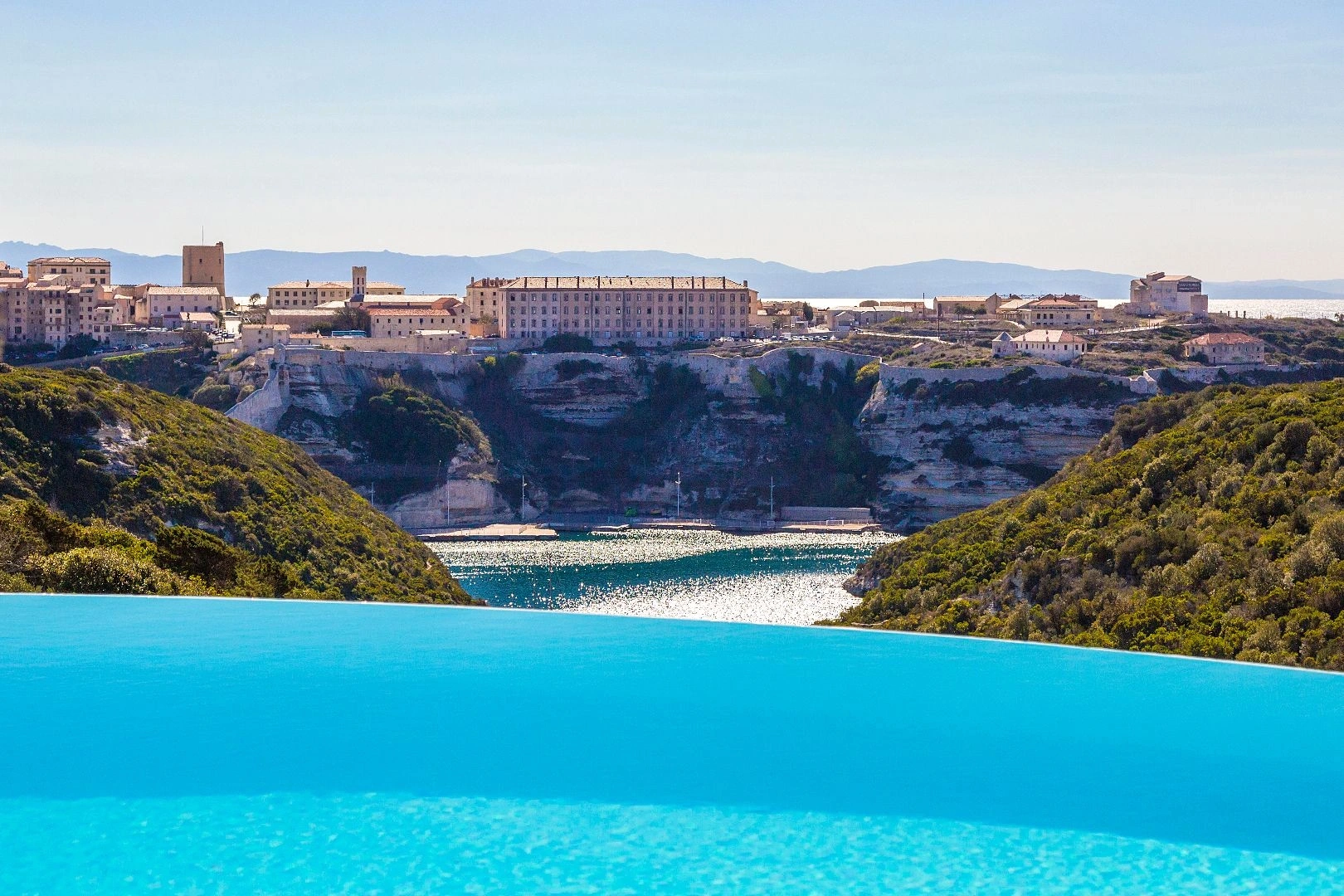
Bonifacio sits on the extreme southern tip of Corsica, balanced on 70-metre white limestone cliffs above the Strait of Bonifacio — just 12 km from Sardinia. That geography shapes everything. The town has a distinctly more Italian than French feel: its old quarter was founded in 830 by Boniface II of Tuscany and spent centuries under Genoese rule. The local traditional dialect, Bonifacino, is actually a Ligurian Italian variant, not Corsican. French is the working language today, but you'll clock Italian menus, Italian signage, and the occasional grandparent who still uses the old tongue.
The town splits cleanly into two worlds. Down below, the marina is all superyachts, designer boutiques, and restaurants charging you for the postcard view. Up top, the Vieille Ville (old town) inside the 9th-century citadel is narrow cobbled streets, medieval churches, and locals who know each other by first name. The two are connected either by a steep walk, a tourist train (Le Petit Train, €6 round trip), or sheer stubbornness. Walking up is worth it, especially early morning before the crowds.
Corsican identity runs deep here even if the Bonifacian dialect is its own thing. The polyphonic singing tradition (paghjella) is recognized by UNESCO, and you can hear live performances at the church of St Francis on Thursday evenings between April and October. Holy Week processions are a serious local affair — not a tourist performance. And the Festi Lumi light festival, in its 11th edition in 2026, has become a genuine point of civic pride.
Economically, tourism has entirely replaced the fishing and wine industries that collapsed in the 20th century. July and August are overwhelming. June and September are significantly better — warm seas, manageable crowds, and you can actually get a parking spot.
cultural_context_headline: CLIFFS, CITADEL & GENOA
Local Customs
Greet with 'Bonjour Monsieur/Madame' — Corsicans appreciate the formal address, and a flat 'hey' or no greeting at all reads as rude.
This applies in shops, restaurants, and even when passing locals on clifftop paths.. Service is always included (service compris) in French restaurants, so tipping is not expected but small amounts are appreciated for genuinely good service.
Don't tip just to be polite — locals don't.. The macagna — gentle teasing and mockery — is a Corsican social sport. Attempting to speak a few words of French or Corsican will get you laughed at affectionately.
Take it well and you'll make friends; take it badly and the shutters come down.. Holy Week processions in Bonifacio are serious religious events, not performances. If you witness one, be respectful: don't photograph without discretion, step back from the route, and keep voices low..
Arriving at restaurants before 7:30pm for dinner is very much not done. The kitchen isn't really ready and you'll feel out of place. Aim for 7:30-8pm.
Lunch service runs 12-2pm, and nothing in between.. The Corsican flag — the Moor's head — is everywhere and deeply meaningful. Don't treat it as kitsch souvenir material in front of locals..
Don't call Bonifacio 'Bonifatch' or mangle the name — the correct local form is Bunifazziu. Locals notice.
Safety
SAFE, STANDARD PRECAUTIONS
Corsica broadly, and Bonifacio specifically, is one of the safer tourist destinations in the Mediterranean. Violent crime is rare. Pickpocketing exists in peak season but is not rampant — the main vulnerability is crowded markets and festival nights. Lock your car and don't leave valuables visible; car break-ins do happen in tourist parking areas.
The bigger safety considerations are environmental. The limestone cliffs are spectacular and unforgiving. Wear proper footwear on the coastal paths — the tourist office actively warns against sandals on the King of Aragon's Staircase (187 uneven steps carved into the cliff face). Sea conditions around the Strait of Bonifacio can turn quickly; check weather before boat trips. Sea urchins are dense around the Lavezzi Islands — water shoes are a smart call.
Driving to and around Bonifacio requires attention. The roads into the citadel are steep and narrow. Parking fills up fast — Parking P5 at the top of the hill is the best option, but it fills by around 10am in peak season. On the broader island, Corsican roads are famously winding, and free-roaming livestock (cows, pigs, goats) cross even main roads without warning. Lower your speed when you see animals grazing nearby.
The Corsican nationalist movement is a political reality, but it has no impact on tourists. Locals extend genuine hospitality to visitors who engage respectfully with local culture.
safety_headline: VERY SAFE
Getting Around
CAR ESSENTIAL, WALK THE TOWN
Getting to Bonifacio: Figari-Sud Corse Airport (FSC) is about a 20-minute drive away. From there, you need a rental car — public transport on Corsica is limited to a few bus routes between major towns and doesn't cover beaches or most of the interesting bits. Book your rental car early, especially for July and August, when agencies run out of compact cars fast. Enterprise/National/Alamo consistently get the best reviews in Corsica. A ferry from Santa Teresa Gallura in Sardinia takes about an hour and docks directly at Bonifacio's port. From Porto-Vecchio, it's a 30-minute drive south on the T40.
Getting around Bonifacio itself: once you're parked, leave the car. The marina area is flat and walkable. To reach the old town, either walk up the steep path from the harbour (doable, sweaty in summer) or take Le Petit Train shuttle (€6 round trip, stops running at 8pm). Best parking is Parking P5 at the top of the hill — flat walk into the citadel, fills by 10am in season. Port lots P1 and P2 are larger but put you at the bottom of the hill. Port parking runs about €18/day. Scooter rentals are available and there's free dedicated two-wheeler parking.
For day trips: a rental car is non-negotiable. Rondinara beach (40 min), Porto-Vecchio (30 min), and the Sperone beaches require driving. The Lavezzi Islands are accessible only by boat from the marina — several operators sell tickets from kiosks along the quay, with the main one being SPMB (17 vessels, various circuits). A 1.5-hour cliff and sea cave circuit runs about €25-30 per person. The sunset cruise with aperitif costs €48.
transport_headline: RENT A CAR
Useful Phrases
Where to Stay in Bonifacio
6 recommended properties